Time Blindness
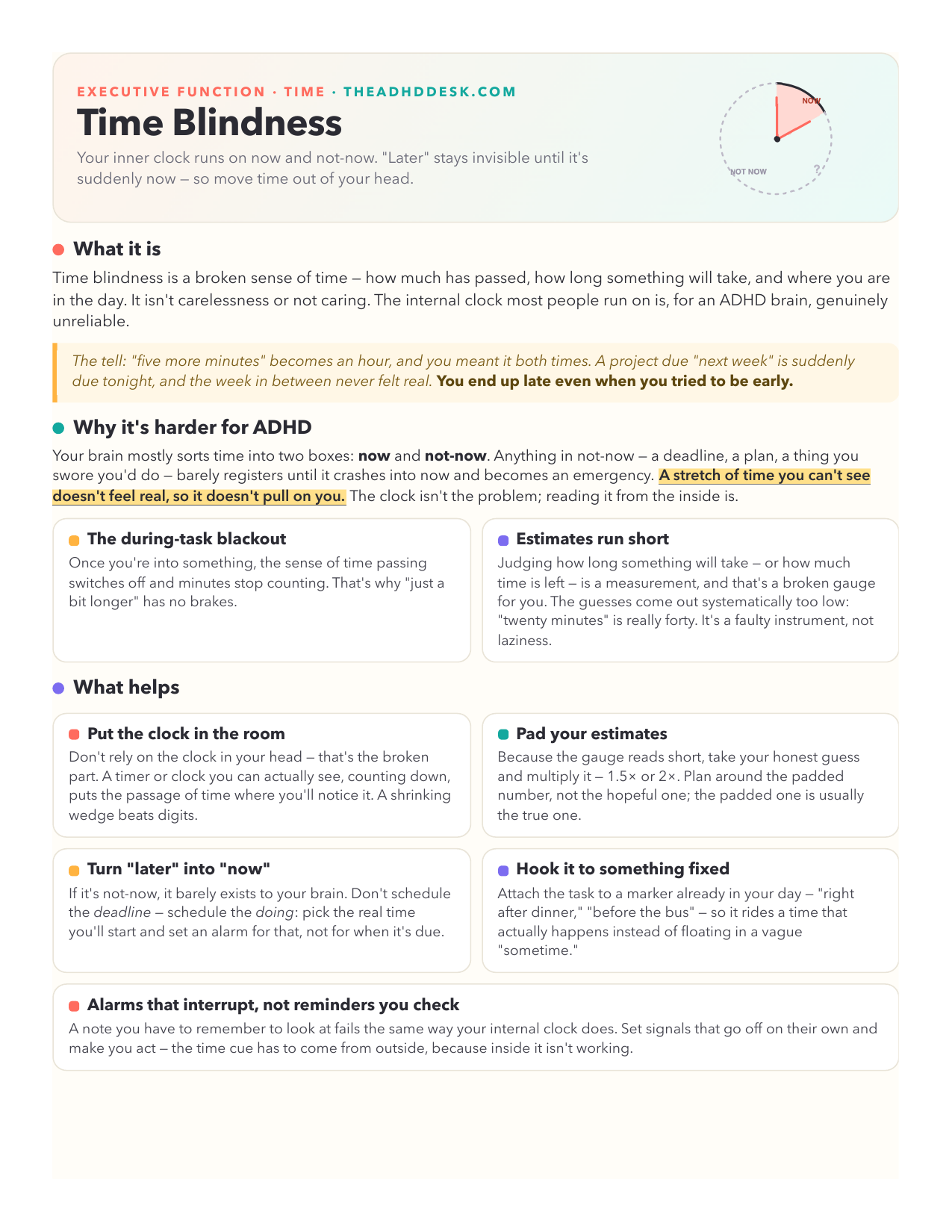
“Five more minutes” becomes an hour; a deadline that felt far away is suddenly tonight. Why an ADHD brain can't read its own clock — it runs on now and not-now — and how to move time out of your head and into the room.
What helps
- Put the clock in the room. Don't rely on the clock in your head — that's the broken part. A timer or clock you can actually see, counting down, puts the passage of time where you'll notice it. A shrinking wedge beats digits.
- Pad your estimates. Because the gauge reads short, take your honest guess and multiply it — 1.5× or 2×. Plan around the padded number, not the hopeful one; the padded one is usually the true one.
- Turn “later” into “now”. If it's not-now, it barely exists to your brain. Don't schedule the deadline — schedule the doing: pick the real time you'll start and set an alarm for that, not for when it's due.
- Hook it to something fixed. Attach the task to a marker already in your day — “right after dinner,” “before the bus” — so it rides a time that actually happens instead of floating in a vague “sometime.”
- Alarms that interrupt, not reminders you check. A note you have to remember to look at fails the same way your internal clock does. Set signals that go off on their own and make you act — the time cue has to come from outside, because inside it isn't working.
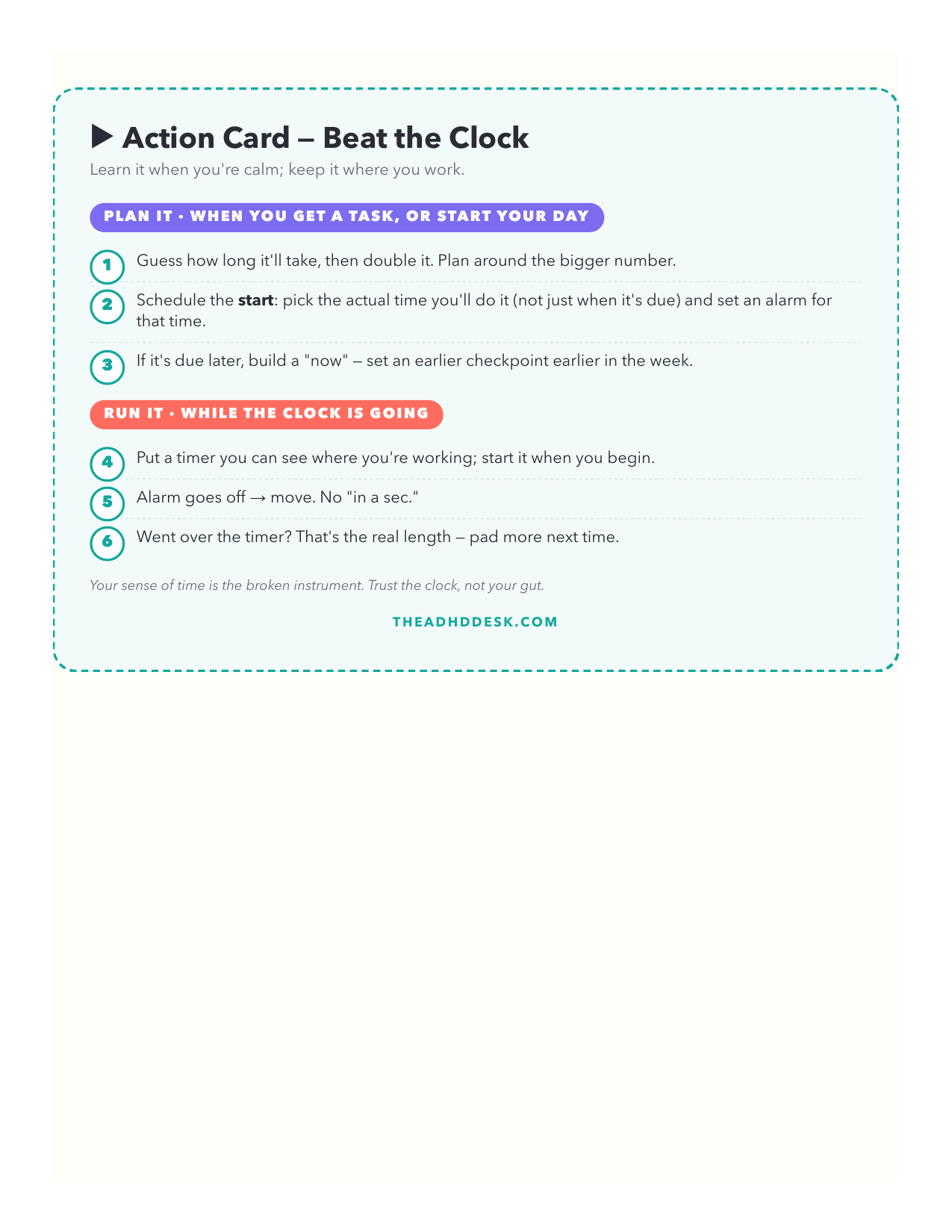
The action card
Plan it · when you get a task, or start your day
- Guess how long it'll take, then double it. Plan around the bigger number.
- Schedule the start: pick the actual time you'll do it (not just when it's due) and set an alarm for that time.
- If it's due later, build a “now” — set an earlier checkpoint earlier in the week.
Run it · while the clock is going
- Put a timer you can see where you're working; start it when you begin.
- Alarm goes off → move. No “in a sec.”
- Went over the timer? That's the real length — pad more next time.
Not medical advice
A practical, plain-language reference. It doesn't replace assessment or treatment from a clinician who knows the individual.